


Adi Shankaracharya
Syllabus: GS1/ History
In News
- The Prime Minister of India paid tribute to Adi Shankaracharya on his Jayanti.
About Adi Shankaracharya
- Adi Shankaracharya (approximately 788–820 CE) was a philosopher, theologian, and saint born in Kalady, Kerala.
- Shankaracharya’s defining contribution to Indian philosophy is Advaita Vedanta, the doctrine of non-dualism.
- He taught that Atman (individual soul) and Brahman (universal consciousness) are identical, not two separate entities. The world’s apparent reality is Maya (illusion) which dissolves upon attaining Jnana (true knowledge).
- He also introduced the Shanmata system organising worship of six primary deities (Shiva, Vishnu, Shakti, Ganesha, Muruga, and Surya) under a single philosophical umbrella presenting each as a valid path to Brahman and reducing sectarian conflict across Hindu traditions.
- Shankaracharya wrote authoritative Bhashyas (commentaries) on the Prasthanatrayi — the three foundational texts of Vedanta: the Brahma Sutras, Bhagavad Gita, and 12 major Upanishads.
- He composed over 72 devotional hymns including Soundarya Lahari, Sivananda Lahari, and Nirvana Shatakam.
Source: PIB
SMILE Scheme
Syllabus: GS2/Governance
Context
- The SMILE Scheme is transforming lives across India by promoting inclusive rehabilitation and social reintegration of vulnerable communities.
About
- Launched in 2022, the Support for Marginalised Individuals for Livelihood and Enterprise (SMILE) is implemented by the Union Ministry of Social Justice and Empowerment.
- It is India’s first unified national framework designed to support vulnerable groups at every stage, from identification and rescue to healthcare, rehabilitation, education, counselling, skill development, and long-term economic independence.
- Key Components:
- One of its components was the sub-scheme to identify, profile, and rehabilitate individuals engaged in the act of begging with their consent.
- The other component of the scheme is for the empowerment of transgender persons.
- Objectives: Make religious, tourist, and historical urban spaces “beggary-free”.
- Progress: As of January 2026, a total of 30,257 individuals have been identified as engaged in the act of begging, and 8,129 individuals have been rehabilitated in different cities.
Source: PIB
Shekha Jheel Bird Sanctuary Designated as New Ramsar Sites
Syllabus: GS3/ Environment
Context
- India designated Shekha Jheel Bird Sanctuary in Uttar Pradesh as its 99th Ramsar Site, with Uttar Pradesh now having 12th sites on the list.
About Shekha Jheel Bird Sanctuary
- It is a freshwater wetland ecosystem, formed by the Upper Ganges Canal in Aligarh, Uttar Pradesh.
- It is a key habitat for migratory birds on the Central Asian Flyway and wintering ground for species such as Bar-headed Goose, Painted Stork and various species of ducks and waterfowl.
India’s Latest Additions in Ramasar site
- Siliserh Lake (Rajasthan): 95th Ramsar site
- Kopra Jalashay (Chhattisgarh): 96th Ramsar Sites
- Patna Bird Sanctuary (Uttar Pradesh): 97th Ramsar Sites
- Chhari-Dhand Conservation Reserve (Gujarat): 98th Ramsar Sites
What is the Ramsar Convention?
- A Ramsar site is a wetland designated as one of international importance under the Ramsar Convention.
- The Ramsar Convention is one of the oldest inter-governmental accords signed by member countries to preserve the ecological character of their wetlands of international importance.
- It was signed on February 2, 1971 in Ramsar, Iran and came into force in 1975.
- India became a signatory to the Ramsar Convention in 1982.
Source: PIB
Truck Mounted Attenuators (TMAs)
Syllabus: GS3/Infrastructure
Context
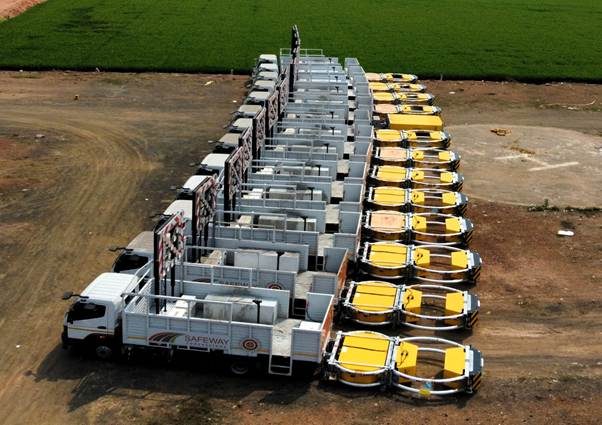
- The Ministry of Road Transport and Highways is deploying advanced safety systems like Truck Mounted Attenuators (TMAs) to enhance safety on National Highways.
What is Truck Mounted Attenuators (TMAs)?
- TMAs are specially designed impact-absorbing safety devices that play a critical role in protecting both workers and road users.
- In the event of a collision, these systems absorb and dissipate kinetic energy, reducing the force of impact. This helps:
- Protect maintenance crews working ahead of the vehicle;
- Reduce injury risks for occupants of the impacting vehicle;
- Minimize the severity of accidents in highway work zones.
- In many ways, TMAs act like an invisible shield — standing between danger and human life.
- The deployed TMAs are equipped with high-intensity wig-wag warning lights, enhancing visibility in low-light and foggy conditions.
Source: PIB
TRAWL Assembly
Syllabus: GS3/ Defence
In News
- The Ministry of Defence signed contracts with Bharat Earth Movers Limited (BEML) and Electro Pneumatics and Hydraulics (India) Private Limited for the procurement of TRAWL Assembly for T-72 and T-90 tanks.
About
- A TRAWL Assembly is a mine-clearing device mounted on the front of a battle tank to safely detect and detonate anti-tank mines before the tank rolls over them.
- The T-72 (Ajeya) is a Soviet-era main battle tank that entered service in 1973, with approximately 25,000 units built globally.
- The T-90 (Bhishma) is a Russian main battle tank that entered service in 1992 — designed as a modernised evolution of the T-72 with significantly upgraded fire control systems, composite armour, and electronic countermeasures.
Source: TH
World Earth Day 2026
Syllabus: GS3/ Environment
Context
- Earth Day is observed annually on April 22 to promote environmental protection and sustainable practices.
About
- History: The idea of observing Earth Day was proposed by Gaylord Nelson, after environmental concerns gained prominence following incidents like the Santa Barbara oil spill.
- Earth Day was first observed in 1970 in the United States as a response to rising environmental degradation.
- The United Nations General Assembly officially designated 22 April as International Mother Earth Day through a resolution adopted in 2009.
- Theme for 2026: “Our Power, Our Planet”.
Source: PIB
Breakthrough Prizes 2026
Syllabus: GS3/ S&T
Context
- The Breakthrough Prize Foundation announced the 2026 laureates.
About Breakthrough Prizes
- The Breakthrough Prizes were established in 2012 by Sergey Brin, Priscilla Chan and Mark Zuckerberg, Julia and Yuri Milner, and Anne Wojcicki to recognise transformative contributions in fundamental sciences.
- The prizes cover life sciences, fundamental physics, and mathematics, and each award carries $3 million.
- Often referred to as the “Oscars of Science,” they have awarded over $340 million since inception.
Life Sciences Awards
- Stuart Orkin and Swee Lay Thein were recognised for advancing treatments for sickle cell disease and beta-thalassemia, leading to the development of Casgevy, the first CRISPR-based therapy that edits patients’ blood stem cells.
- Jean Bennett, Katherine High, and Albert Maguire were also awarded Life Sciences Prize for developing the first FDA-approved gene-replacement therapy that restores vision in Leber congenital amaurosis, with long-lasting benefits.
- Rosa Rademakers and Bryan Traynor were honoured for identifying a key genetic mutation responsible for ALS and frontotemporal dementia, enabling genetic testing for affected families.
Mathematics Prize
- Frank Merle was awarded for advancing the understanding of dynamic systems and wave evolution, including proving that certain equations can become infinite in finite time, overturning earlier assumptions.
Fundamental Physics Prize
- Collaborations at CERN, Brookhaven National Laboratory, and Fermilab were recognised for precision measurement of the muon’s magnetic moment, testing the limits of existing physical theories.
- A Special Breakthrough Prize was awarded to David Gross for lifetime contributions, including work on the strong nuclear force.
Source: TH
Salween River
Syllabus: Places in News
In News
- Alarming levels of arsenic contamination have been detected in the Salween River.
- Arsenic is a naturally occurring toxic metalloid that leaches into river systems from geological formations, mining activities, and industrial discharge.
About the River
- The Salween is one of Asia’s great rivers known by different names across the countries it flows through: Nu in China, Thanlwin in Myanmar.
- It is the second longest river in Southeast Asia after the Mekong, and the longest free-flowing river without a dam in Southeast Asia.
- The river originates from the Tanggula (Tangula) Mountains on the Tibetan Plateau.
Source: TOI
Samriddh Gram Initiative & WSIS Prizes 2026
Syllabus: Awards/Miscellaneous
Context
- Recently, Samriddh Gram Initiative was nominated for the WSIS Prizes 2026 under Action Line AL C6: Enabling Environment. This marks the global recognition of India’s use of digital infrastructure for inclusive rural development.
About Samriddh Gram Initiative
- Samriddh Gram: Integrated Phygital Service Delivery Model, enabled by BharatNet, is an initiative of the Department of Telecommunications, Ministry of Communications.
- As a pilot initiative, Samriddh Gram integrates physical and digital (‘phygital’) service delivery to provide multiple citizen services in rural areas.
- The initiative is supported by the Digital Empowerment Foundation for field operations and community mobilisation.
- Recently, India’s first Samriddhi Kendra was inaugurated at Umri village in Guna, Madhya Pradesh.
| World Summit on the Information Society and WSIS Prizes |
| 1.The World Summit on the Information Society is a global multi-stakeholder platform established in 2004 to advance digital development and inclusive information societies. 2.The WSIS Prizes, launched in 2012 under the WSIS Stocktaking Process, recognise ICT-driven projects contributing to sustainable development and the Sustainable Development Goals. 3.The prizes serve as a global mechanism to identify and promote impactful digital initiatives, recognising stakeholders as winners and champions for advancing WSIS Action Lines and the Global Digital Compact. |
Source: PIB
Previous article
Food Processing Ecosystem in India
Next article
Promotion and Regulation of Online Gaming Rules 2026
